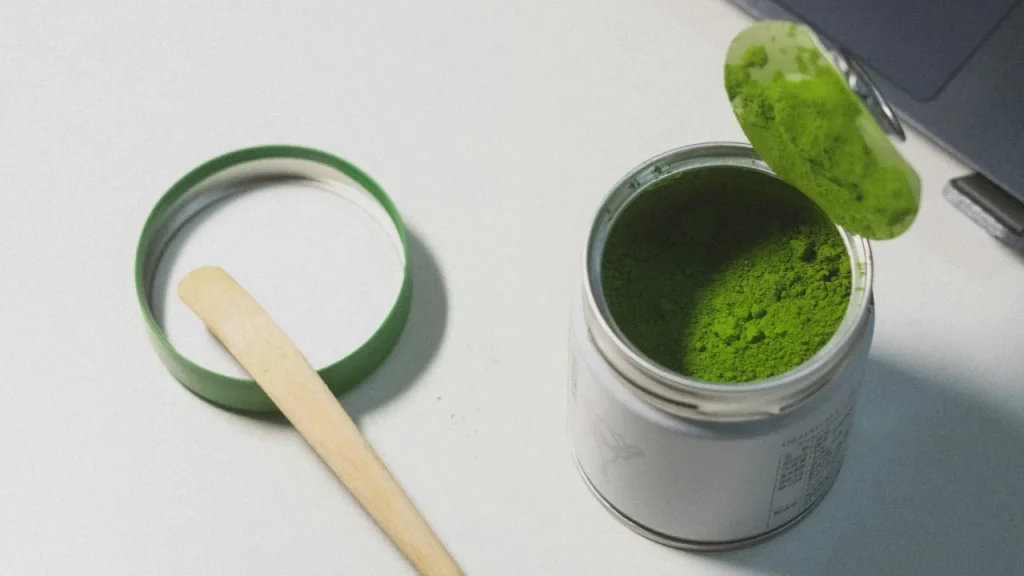
Short answer: The best matcha for lattes is a blend of first-flush and second-flush matcha, not first flush alone. First flush gives colour and umami, but its taste is delicate and milk covers it. Second flush is stronger and more bitter, so it still tastes like matcha after you add milk and sugar. A blend gives you both, at a price a café can live with. We reached this answer after about 1,000 trial lattes made with every grade we could buy.
“Matcha for lattes” means matcha chosen for how it tastes in milk, not for how it tastes whisked with water. Sellers call it latte grade, café grade, daily grade or culinary grade. We could not find a Japanese public standard that defines any of these words, or “ceremonial grade”. So a grade name tells you little. The harvest in the tin tells you more.
We run WOW!CHA, a matcha latte food truck in Tokyo. We sell the matcha we use to cafés abroad. This guide explains what we learned, and how to test a latte matcha yourself. For prices and minimum orders, see Wholesale Matcha from Japan.
First flush, second flush and a blend in a latte
| First flush only | Second flush only | Blend of both | |
|---|---|---|---|
| Taste with water | Soft, rich in umami, little bitterness | Stronger, more bitter | In between |
| Taste in milk | Gets lost | Clear matcha taste, can be harsh | Clear matcha taste, rounder |
| Colour in the cup | Bright green | Duller green | Green enough to show in milk |
| Cost | Highest | About half of first flush | In between |
| Best use | Whisked with water | Baking, strong sweet drinks | Lattes |
The taste and colour rows are what we saw in our own trial cups. The cost row is from the price data below.
Why first flush alone gets lost in milk
First flush is the spring harvest. It is the most prized tea of the year, and for good reason when you drink it with water.
The harvests differ in what is in the leaf. A study of green tea leaves by a Japanese college of technology compared harvests over four years and found: “The amounts of theanine, free amino acids and caffeine were the highest in the first flush, and the amounts of tannin were the highest in the second flush.” (National Institute of Technology, Numazu College, 2024 (checked Nov 20, 2026)). Theanine and amino acids give umami and sweetness. Tannin, which is mostly catechins, gives bitterness and astringency. The study looked at ordinary green tea, not the shaded leaf used for matcha, but the direction matches what we taste.
Shading pushes matcha further the same way. A document on Kyoto Prefecture’s website says that in shaded teas such as gyokuro and matcha, the change from theanine to catechins is held back, which gives more umami and less astringency (Kyoto Prefecture (checked Nov 20, 2026)).
So a first-flush matcha is soft by design. That softness is the problem in a latte. Milk is rich, and most lattes are sweetened. A 2010 study in the journal Milk Science reported that milk components suppress the astringency of tea catechins (Miura and Akuzawa, Milk Science (checked Nov 20, 2026)). Milk takes the edge off any tea. When the tea has little edge to begin with, what is left tastes like sweet green milk.
That is what we found in the cup. Lattes made with first flush alone looked beautiful and tasted faint. To get a clear matcha taste we had to use more powder, and the cost per cup stopped making sense.
What second flush adds
Second flush is picked in early summer. It has more of the bitter, astringent side of tea. With water, that can be too much. In milk, it is what you want: the matcha taste comes through the milk and the sugar.
Second flush alone has two weak points. The colour is duller, and a latte sells with its colour. The taste can also turn harsh, with bitterness and not much else behind it.
Why a blend works best
A blend of the two harvests covers both weak points. The first flush brings the green colour and the umami. The second flush brings the strength that milk cannot hide. In a latte you taste matcha first, and it finishes round, not sharp.
A blend is also steadier. Each harvest changes from year to year. A blender can adjust the mix to keep the same taste in the cup, and a café needs the same drink every day.
This is the opposite of what many labels suggest. You will often read that the highest grade makes the best latte. For drinking with water, the highest grade is the best. For a latte, our trial cups said otherwise.
What the two harvests cost
Price points the same way. For tencha, the leaf that is ground into matcha, the average price of the 2025 crop in Japan was 10,030 yen per kilogram for first flush and 4,950 yen per kilogram for second flush. The average for all harvests was 8,562 yen (Ministry of Agriculture, Forestry and Fisheries, October 2026, data from the national tea producers’ federation (checked Nov 20, 2026)). These are prices for unground leaf at origin, not for finished matcha.
Second-flush leaf cost about half as much as first-flush leaf. A blend sits between the two. In a year when matcha is short and prices are high, that gap decides whether a latte makes money. For the supply picture, see Matcha Shortage 2026.
How to test a latte matcha in your café
Do not judge a latte matcha by whisking it with water. Test it the way you will sell it.
- Make your real drink. Use your milk, your sweetener and your cup size. Test iced if you sell iced.
- Taste three in a row. Put a first-flush matcha, a second-flush or culinary matcha and a blend side by side. Use the same amount of powder in each.
- Look at the colour in the milk. A powder that is bright in the tin can look pale in the cup.
- Taste again after ten minutes. Ice melts and the drink gets thinner. The matcha should still be there.
- Work out the cost per cup. Divide the price of the bag by the number of drinks you get from it. If you need extra powder to taste the matcha, count that.
- Ask what is in the tin. Ask the supplier which harvests are in the matcha. “Ceremonial” is not an answer. For the other questions to ask, see our matcha supplier checklist.
How we do it
WOW!CHA is a matcha food truck at Asakusa Rokku Broadway (since June 1, 2026) and at Tokyo Dome City. We have served more than 6,000 cups. Before we opened, we bought every grade we could, from the most expensive first flush down, and made about 1,000 trial lattes. A blend of first and second flush won, so that is what we serve, and we ship the same matcha from Tokyo. WOW!CHA is run by Rim Entertainment Co., Ltd.
We do not whisk each cup. We make a matcha concentrate before service and pour it over milk and ice. A blend holds up well made this way. See how cafés make iced matcha lattes without a whisk.
See the matcha powder, shipping and terms →
Related guides: Wholesale matcha prices and minimum orders / Matcha supplier checklist / Matcha shortage 2026 / Ceremonial vs culinary grade matcha
FAQ
What is the best matcha for lattes?
A blend of first-flush and second-flush matcha. First flush gives colour and umami. Second flush gives a strong taste that milk does not hide. In our own trial of about 1,000 lattes, a blend beat both first flush alone and second flush alone.
Can you use ceremonial matcha for lattes?
You can, but it is a poor use of it. Sellers usually describe ceremonial matcha as first flush. Its soft taste gets lost in milk, so you need more powder to taste it, and it costs the most.
Is culinary matcha good for lattes?
It depends on what is in it. “Culinary” is not a regulated word. Some culinary matcha is a good blend that works well in milk. Some is late-harvest leaf that tastes harsh and looks dull. Ask which harvests are in it, and test it in your own drink.
What is latte grade matcha?
It is a name sellers use for matcha meant for milk drinks. We could not find a public standard for it in Japan, so each seller decides what it means. Check the harvest and test the taste.
Why does my matcha latte taste weak?
Most often the matcha is too soft for milk, or there is too little of it. Try a blend that includes second flush before you add more powder. More powder raises your cost per cup.
Is first flush more expensive than second flush?
Yes. For the 2025 crop in Japan, tencha averaged 10,030 yen per kilogram for first flush and 4,950 yen for second flush, according to Japan’s agriculture ministry.
Can a café buy the matcha you use?
Yes. We ship the matcha we serve at WOW!CHA to cafés and restaurants abroad. See the shop page for sizes, shipping and terms.