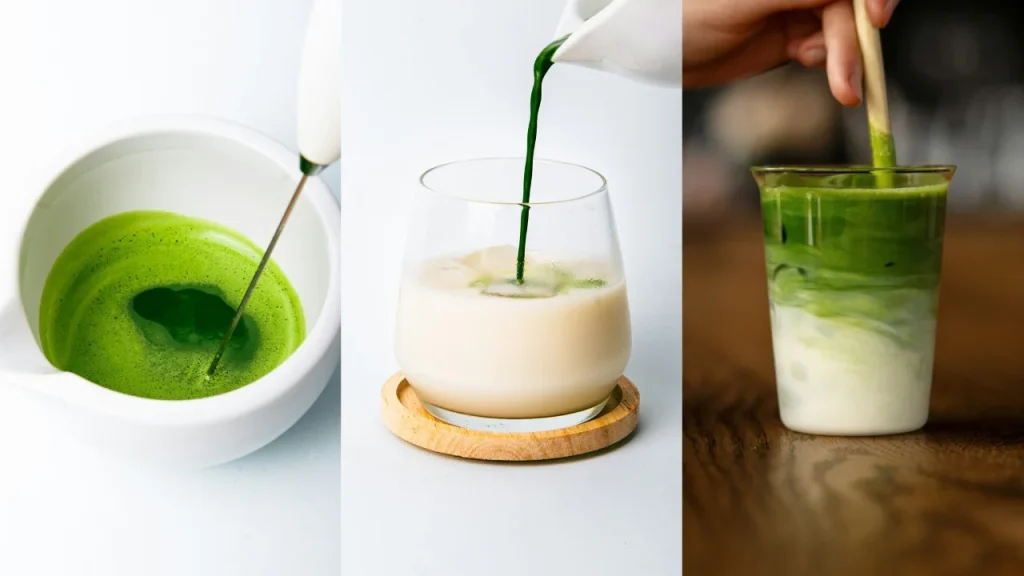
At WOW!CHA we do not whisk matcha lattes to order. We make a matcha concentrate before service, keep it cold, and build each drink by pouring a measured dose over milk and ice. That is how one or two people serve a queue at a food truck, and it is how the two-layer look in a clear cup happens by itself. This guide explains the method, the ratio thinking behind it, and where the bamboo whisk still belongs.
The short answer: concentrate, dose, pour
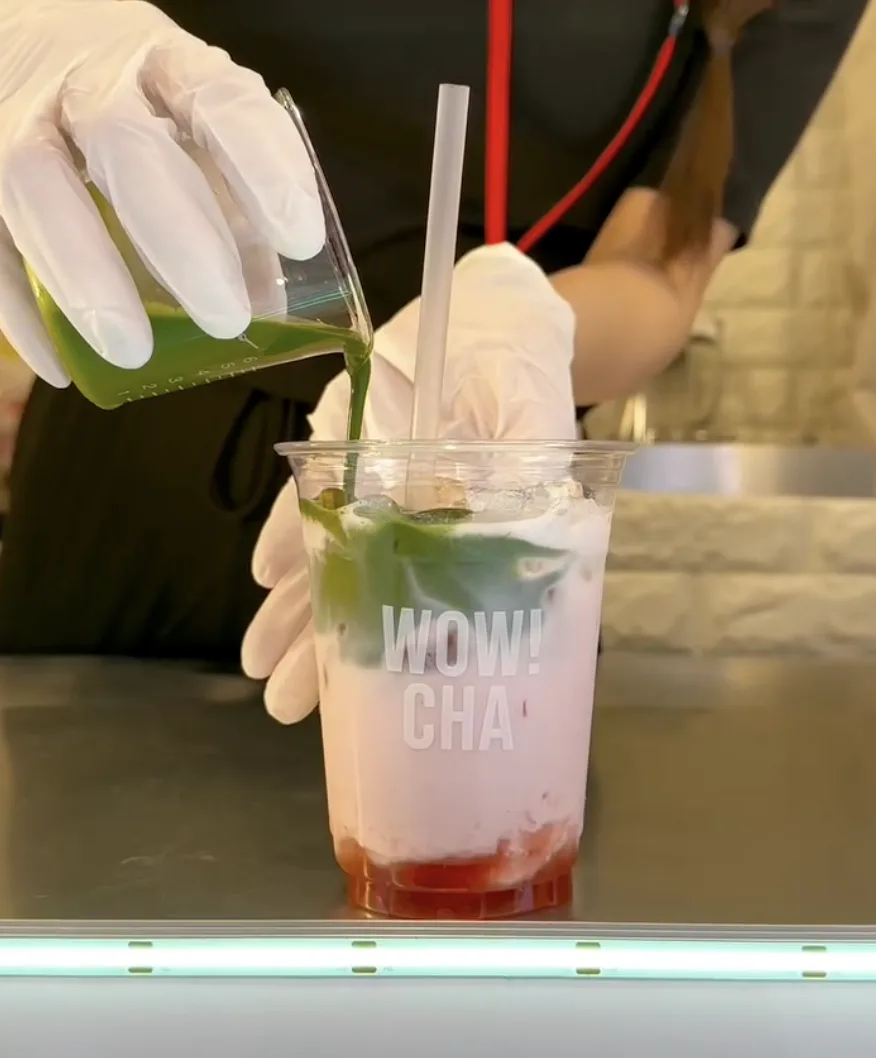
A café iced matcha latte has three parts: a matcha concentrate, cold milk, and ice. The concentrate is made in a batch (matcha plus water, mixed until smooth), held cold, and dosed per cup. Milk goes into the cup first, then the concentrate is poured on top. Poured gently, it sits on top and forms a green layer over white. The customer stirs when they are ready to drink.
Compare that with the recipes that rank for “iced matcha latte” online, which are written for one cup at home:
| Source (checked Nov 9, 2026) | Matcha | Water | Milk | Method |
|---|---|---|---|---|
| Chamberlain Coffee | 1 tsp (about 2 g) | 2 oz hot | 6–8 oz cold | Whisk matcha with hot water first, then add milk and ice |
| Yunomi.Cafe | 4 g | 60 ml at 60°C | 160 ml | Whisk with a chasen, pour down the side of the ice to layer |
| Love and Lemons | 1 tsp | 2 oz cold | 6 oz | Whisk, electric frother, or blender |
| Tasting Table | 1–2 tsp per cup of liquid | – | – | Whisk, handheld frother or cocktail shaker |
| japanesetea.sg (café guide) | 2–2.5 g per 50 ml milk | not stated | basis of the ratio | not stated |
Every home recipe is built around a per-cup mixing step, whether that is a whisk, a frother, a blender or a shaker. Only the last one thinks in café terms (matcha per millilitre of milk), and even it does not describe a workflow. The gap between “one good cup at home” and “a weekend of consistent cups” is the concentrate.
Why we batch a concentrate instead of whisking per cup
Speed. Chamberlain Coffee puts whisking at 15–20 seconds per cup, before sifting, rinsing and drying the whisk. In a queue that adds up to a second person doing nothing else. With a concentrate, the per-cup work is a pour.
Consistency. Hand-whisking varies by person and by how tired they are. A batch mixed once gives the same strength to every cup for the rest of the shift.
The suspension problem. Matcha does not dissolve; as Tasting Table puts it, it “creates a suspension”. In our experience a concentrate that is mixed thoroughly once, stored cold and stirred before dosing holds that suspension better than a quick whisk into cold milk.
Labour. At WOW!CHA we run each truck with one or two people and have served more than 6,000 drinks since June 2026 at Asakusa and Tokyo Dome City. That is only possible because nothing is whisked during service. The matcha concentrate, the milk base and the fruit bases are all prepared in the kitchen beforehand.
Why we keep the whisk for straight matcha
The chasen (bamboo whisk) exists to aerate a small bowl of matcha and water into a smooth usucha. That is its job and it does it well. In a latte, we find the foam disappears into the cold milk within seconds, and whatever aroma the whisking opened up is covered by dairy and sweetness.
Our view, after roughly 1,000 test cups during development: for an iced latte, a well-mixed concentrate tastes at least as good as a cup whisked to order, and usually better because it is more consistent. This is our own tasting conclusion, not a published study, and your matcha and milk may behave differently. Where whisking clearly wins is straight usucha with nothing added. If you serve both, whisk the straight bowls and batch the lattes.
Ratio thinking for cafés (without a recipe)
We do not publish our exact gram-per-cup or concentrate ratio; it took about 1,000 cups to settle and it is tied to the specific matcha we buy. But the way to arrive at your own number is straightforward.
- Decide the milk volume per cup first. Fill your actual cup with your actual ice, then measure how much milk it takes. That number, not the cup size printed on the sleeve, is what everything else scales from.
- Set matcha per millilitre of milk, not per cup. The japanesetea.sg café guide suggests 2–2.5 g per 50 ml of milk, which is strong. Home recipes land nearer 2 g per 180–240 ml (Chamberlain, Love and Lemons). Taste at three points in that range with your actual milk and your actual matcha, with people who are not matcha fans.
- Fix the concentrate strength so the dose is a round number. If a cup needs X grams of matcha and your dose is a fixed volume of concentrate, the batch is simply X grams per dose of water, scaled up. A round dose makes training a new hire a one-sentence job.
- Re-taste when the matcha changes. Lots vary. When a new bag tastes different, re-run step 2 before service, not after the first complaint.
Getting the two layers right
The layer comes from pouring the concentrate gently over the milk and ice. The table below is what we have learned from our own service, not a published method.
| Problem | Likely cause | Fix |
|---|---|---|
| Layers mix immediately | Concentrate poured fast | Pour slowly over the back of a spoon or down the ice |
| Green layer is thin and pale | Dose too small for the cup, or concentrate under-mixed | Check dose against milk volume; stir the concentrate before each dose |
| Sediment at the bottom | Concentrate not re-stirred, or whisked per cup into cold milk | Batch and stir; dose from the middle of the container |
| Colour dull or brown | Matcha oxidised, or concentrate held too long | Keep the concentrate cold and covered; make smaller batches more often |
Hold times for a matcha concentrate are short. We make what we will use within the service and keep it refrigerated; when the colour drifts from bright green toward olive, we discard it and make a fresh batch.
Cost in a shortage year
The matcha itself is now the expensive part. Supply Chain Dive reported Kyoto tencha trade prices up 265% from 2024 to 2025, and NBC News put the average US matcha latte at $6.15 in 2025, up from $5.84 a year earlier (Square data cited by NBC). A concentrate helps here too: dosing by volume means every gram you pay for ends up in a cup, not on the whisk, the sieve or the bottom of the bowl.
The wrong response is to cut grams per cup until the drink tastes of milk. The right one is to use a matcha that was selected for lattes rather than for the tea bowl, and to lock the ratio so the cost per cup is known. We cover what café owners can do about supply in Matcha Shortage 2026: What Café Owners Can Do.
What we sell
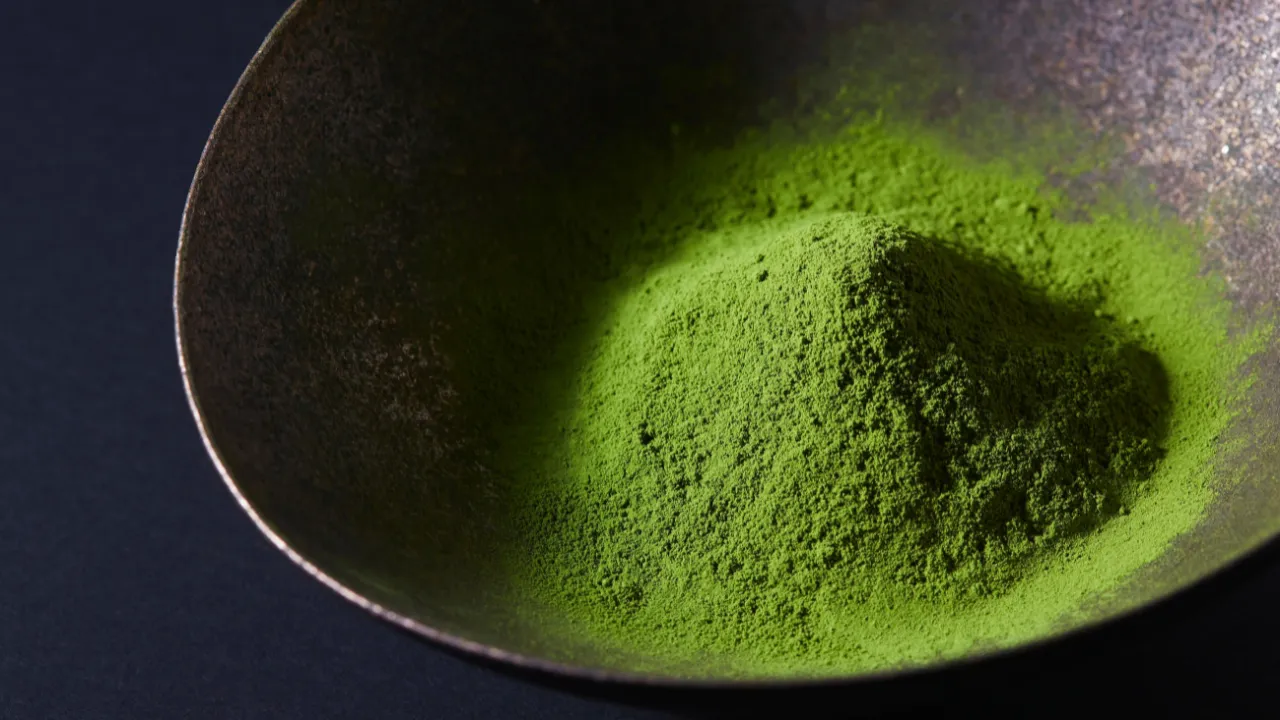
The matcha we pour every day in Tokyo is available as 30 g tins and 1 kg bags, shipped from Tokyo to cafés abroad. For the US, tins ship with duties and shipping included; 1 kg bags ship with shipping included and any import duties settled by the recipient on delivery. It was selected for exactly this use: a concentrate that stays bright and holds a layer over milk.
Comparing suppliers? See wholesale matcha from Japan: prices, minimum orders and lead times.
See the matcha powder, tins and 1 kg bags →
Related guides: How to buy matcha direct from Japan · Where to buy matcha powder in Asakusa · Matcha supplier checklist: 8 checks before you order · Best matcha for lattes: why a blend works · Matcha catering in Tokyo for group events
FAQ
How do coffee shops make matcha lattes so fast?
The method we use: prepare a matcha concentrate before service and dose it per cup over milk and ice. Nothing is whisked to order, so one or two staff can keep up with a queue.
Do you need a bamboo whisk to make an iced matcha latte?
No. A whisk is for straight usucha. For lattes, in our experience, a concentrate mixed in a batch (with a frother, blender or shaker) gives a smoother and more consistent result than whisking each cup into cold milk.
What is the right matcha to milk ratio for a café latte?
There is no single number. Published guidance ranges from about 2 g per 180–240 ml of milk in home recipes to 2–2.5 g per 50 ml in one café guide (checked Nov 2026). Taste three strengths with your own matcha and milk, then fix the dose.
Why does my matcha latte not layer?
In our experience the most common cause is pouring the concentrate too fast. Pour it slowly over ice or the back of a spoon.
How long does matcha concentrate keep?
Our practice: make it for the service, keep it cold and covered, and stir before each dose. When the colour drifts from bright green toward olive, we discard it and make a fresh batch.
Can a café buy the matcha you use?
Yes. 30 g tins and 1 kg bags ship from Tokyo to international customers. US tins include duties and shipping; 1 kg bags include shipping, with any duties paid on delivery. Details on the shop page.
Sources checked November 9, 2026